


There’s this passage in the Gospels (Matthew 12:31-32; Mark 3:29) where Jesus declares that “blaspheming the Holy Spirit” is an unforgivable sin. The first time I read this (likely as a pre-teen1) I experienced great consternation, and my dad reassured me (or tried to) by telling me that if I was concerned about committing that sin, I probably hadn’t. I am hoping a similar rubric applies in the following case, but am open to the possibility that it doesn’t.
On Wednesday night I finished reading Dr Diane Langberg, Ph.D.’s When the Church Harms God’s People. It’s a brief but important book, and I recommend it, even though it kept me awake all night.
Why it kept me awake is because of Langberg’s incisive focus on institutions and systems becoming a vehicle for enabling abuse, and particularly this quote from Jerry Pournelle2:
In any bureaucracy, the people devoted to the benefit of the bureaucracy itself always get in control and those dedicated to the goals that the bureaucracy is supposed to accomplish have less and less influence, and sometimes are eliminated entirely.
If you’re reading this (unless you subscribed in the last month which—thank you! and welcome! and sorry this is probably about to get weird, although honestly it would have one way or another), you already know that last fall I incorporated the spiritual formation ministry I’ve been operating for the last ten years. You also know that said incorporation keeps throwing me for a loop, but the biggest loop, which I haven’t really articulated here yet, is an intuited concern about exactly what the above quote predicts. Because clearly, incorporating a nonprofit in a society set up the way it presently is in the United States of America in 2026, involves bureaucracy.3 Like for example the stuff I was wrestling through in the last post.4 And there’s already been some human fall-out. I don’t feel like we’ve been abusive, but maybe the system inherently is? I don’t know. Some of you would probably say so.
Yesterday I met with someone who reminded me of really important things like,
“All entities—including individual bodies—require definition. By virtue of that, there will always be people who end up positioning themselves outside any given entity.”
“You are working with a vulnerable population, some of whom may be reactive even to best practices.”
“You are not claiming to be anything other than human. You will make mistakes.”
“The question is, examining this going forward, how does this inform your practice, reducing harm as much as possible?”
I’m glad I met with that person. Because truly The Pilgrimage wasn’t going to be able continue as the fiscally sponsored, somewhat undifferentiated-from-myself ministry it has been. It was either going to need to shut down or turn into some different kind of entity that involves bureaucracy. It didn’t seem like it was time to shut it down, and so here we are. I just want to be alert to make sure that I, and it, don’t lose our souls and our first focus, who is Jesus.
I’m also glad I read Langberg’s book, though. I hope it, and items like it, will keep me honest, humble, and on-task. I hope it will help other individuals and organizations with the same thing.
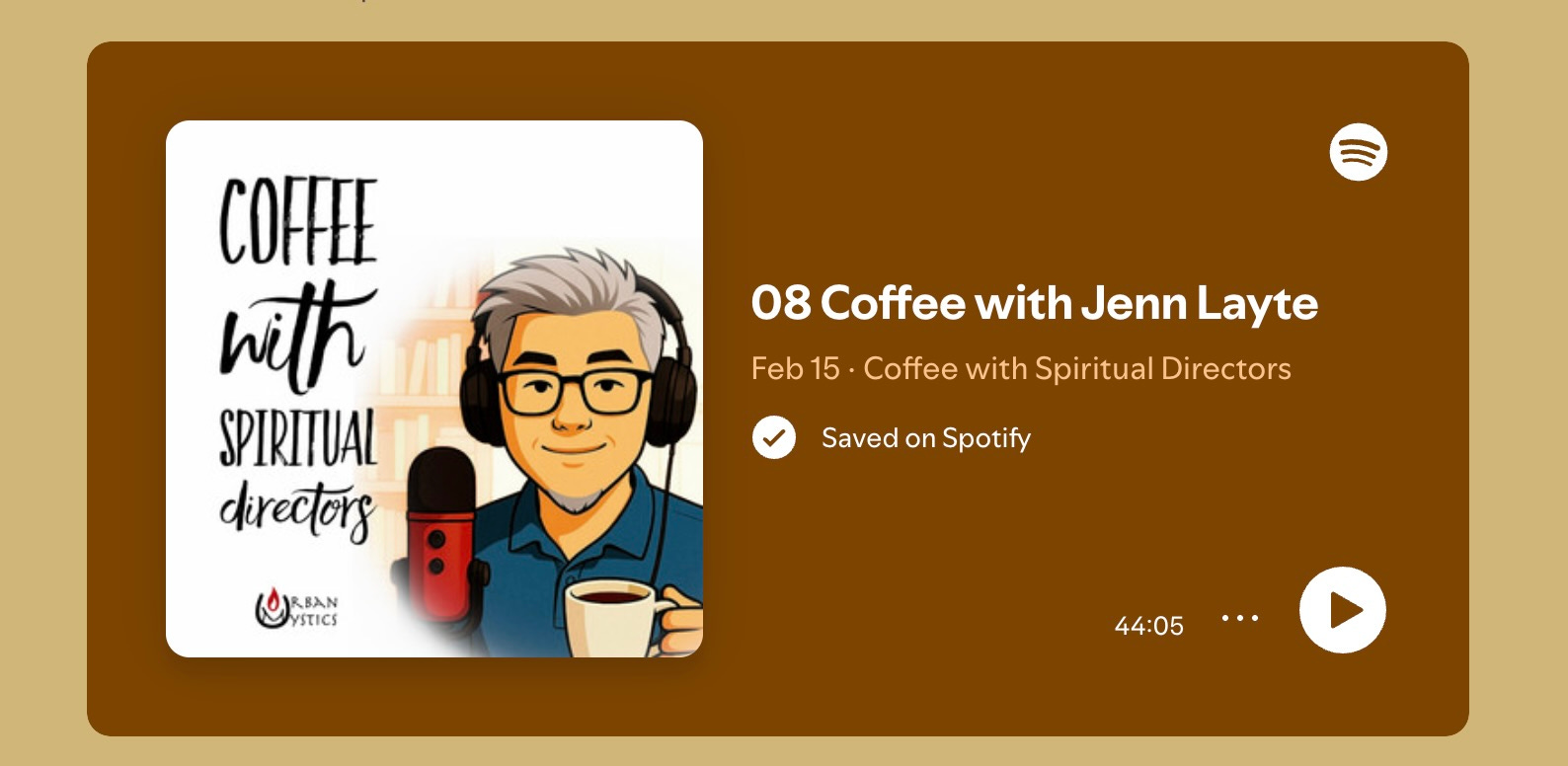
If I had been writing here more frequently you would already know about this, but fellow spiritual director, Dan Lee, interviewed me for a spiritual direction podcast he has started for his DMin program (through another institution than the one where I’m getting mine). We both hope you’ll listen!
—which I suspect is not what we call that age group in the 2020’s, but I was one in the 1980’s and that was the term
Jerry Pournelle as quoted in Diane Langberg, When the Church Harms God’s People, Brazos Press 2024, 72.
I just have to tell you that next time I see that meme that asks what’s my nemesis spelling word, I’m going to answer beuro beaura bureaucracy.
Regarding that post—originally I said that there would be no more “Notes on Pilgrimage” content here, but that’s impossible because here is where I be human (and not a bureaucrat) about The Pilgrimage. So instead I ended up writing a policy that the “Notes on Pilgrimage” heading is proprietary to me, Jennifer A G Layte, for when I’m personally writing about The Pilgrimage. See what I mean about bureaucracy? (Hey! I actually spelled it right that time.)